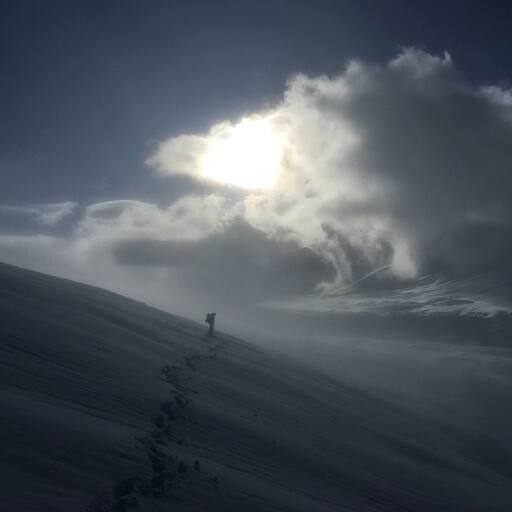
A personal narrative of climbing a 6000m hill in Nepal.
During the summer months the sun heats up the soil in India while the ocean around it resists, sweating out its moisture. The lower atmospheric layers directly above the subcontinent expand in volume as they are being toasted by the soil. Not unlike a hot air balloon, the air above India escapes up and the air from above the ocean comes to replace it. The moist winds from the ocean hit the Himalayas where exposed to cold, a massive condensation occurs. This is my understanding of why when I arrived in Kathmandu in July, I found myself under a heavy rain that lasted no less than three days.
I was looking for a mountain adventure but everything I could see was tourism. The advertised consumer products were called treks and people "did treks" as if they were lines of cocaine.
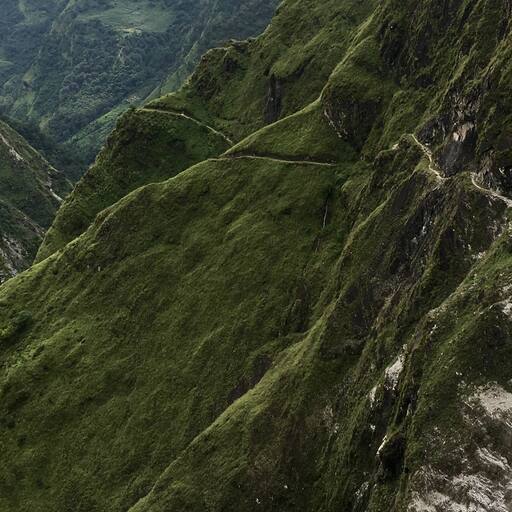
A trek in Nepal is a chain of guesthouses connected by walking trails with staircases cut in the rock. Often they begin in the jungle hills south of the Himalayas at around 1500m elevation and, following a river valley, they reach mountain passes as high as 5000m.
A group of people who "did a trek" admitted to me that they picked a tourist company based on Google reviews, visited their office, paid money and, later on, followed a guide. This contradicted my idea of what a mountain adventure was.
As always, the people lied that everything they experienced in their lives was good and so were the treks.
On the internet I found that while doing a trek with no guide was illegal it was easy to get the necessary permit for Annapurna Conservation Area by visiting their office in Kathmandu and leaving the "guide" field empty in the paperwork. After buying some conventional warmer clothes I went to a tourist company and arranged a jeep going to Besishahar where the beginning of a popular trek was marked on my map.
On the next day I was confused because there was a new asphalt road in perfect condition instead of the trek. Later I learned that the tourist companies adapted to this unpleasant road by "doing" half of the former trek by jeep and only then getting out of it to walk. The guesthouse owners on the first half were visibly upset as they watched the jeeps roll by. The only part of the trek that did not run along the road was a high mountain pass that was normally crossed by trekkers in two days (with no jeep). Afterwards they got into another jeep waiting for them on the other side.
The guesthouse menu was always the same because it was neither designed nor priced by the owner but rather by something called a District Hotel Management Committee in order to prevent competition between the guesthouses. The prices were still cheap for foreigners but high in the context of Nepali markets where no such conspiracy was taking place.
I spent a month in the Annapurna Conservation Area gaining some understanding of what the Himalayas were like. At the end of it I knew what was bad in Nepal but most importantly I knew what was good.
As I was descending after visiting a famous glacial lake some Philipinos started using my only credit card to run their ads on Facebook, then the screen of my phone turned permanently black in the rain and finally I broke the operating system on my laptop by typing something stupid into a black window. Perhaps I was sick of the Annapurna Circuit and I broke it on purpose as an excuse to get out of there.

Reinhold Messner thought that mountain climbing was a sign of degeneration in mankind. There's a popular misconception that people climb because of the beautiful view from the summit and not because of the degeneracy. Pokhara is the second largest city in Nepal and it can serve as a reminder that this misconception is not true. Good views are available without any mountaneering.
I met Alban in a hostel in Pokhara. He "did" the same trek and I think he also didn't like to talk about it because he felt like it was embarrassing even though many things about it were real and good. Alban travelled from France to Nepal by land visiting everything in the middle. Once I saw a Taliban visa stamp in his passport. He was a philosopher and, not unlike myself, a complete degenerate.
In a day or two I knew that we could become friends in the Russian sense of the word and in a couple of weeks we were looking for a 6000m mountain to climb.
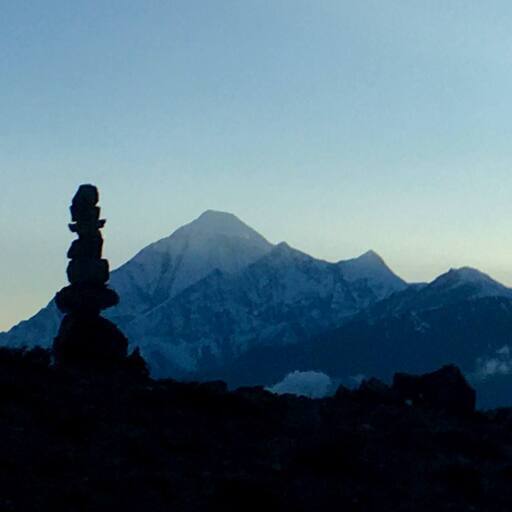
The big snow mountain in the background is Dhaulagiri.
Dhampus is the little one on the very right of the horizon with it's south-west ridge seen in dark blue descending left to Kali Gandaki river.
In the middle the zig-zag face with 3 peaks is Tukuche.
This picture was taken on Oct 7 2024 from a little creek valley in Upper Mustang (from North-North-East). Dhaulagiri is exactly 50km away.
Unlike with Annapurna and Manaslu, Nepali goverment did not bother to create a Dhaulagiri Conservation Area, not requiring neither guide nor permit to enter. The gorge west of Dhaulagiri was remote, and the weather was bad too often for a trek there to become a thing. The 8000m peak, however, had to have a tourist product around it and hence the Dhaulagiri Circuit was born. The best practices of search engine optimization demanded the tourist companies to make detailed pages for it on their websites, even though very few customers were willing to go.
The end of Dhaulagiri Circuit was going through a Hidden Valley that had a chain of 6000m hills with glaciated summits. From the other side they looked like mountains and Dhampus peak was the first such hill. The tourist companies added another page to their websites and charged 3 to 7 thousand American dollars per person to climb Dhampus peak.
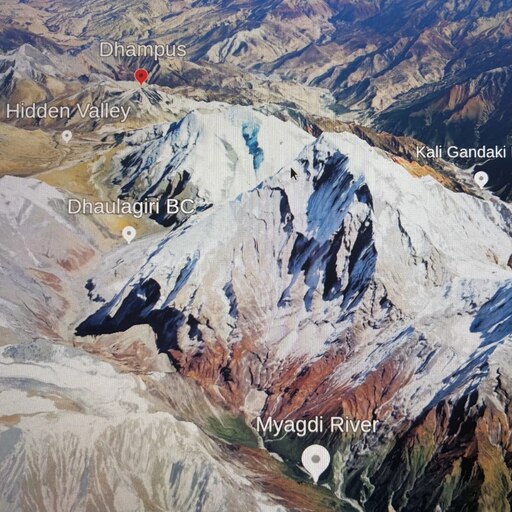
This is the view of the same mountains but from exactly the opposite side. In fact the location of the previous photo is visible directly above the letter "u" in Dhampus on a very minor tributary to upper Kali Gandaki river. This time, looking from the south, Dhaulagiri is on the right with its West gorge poorly drawn in the dark shadow. The Myagdi river has its source in a melting glacier on which stands the base camp. We climbed it at night under the influence of LSD with no ice gear.
Since Dhampus peak was usually climbed from the west we abandoned our South East ridge plan in favor of going up the Myagdi river and climbing from Hidden Valley. It was good for acclimatization and appeared more fun than being stuck on the same ridge for a week.I bought a map for that region and it was written that the ice axe and crampons were required in certain places. We did not believe the map but clearly there was going to be some real shit.
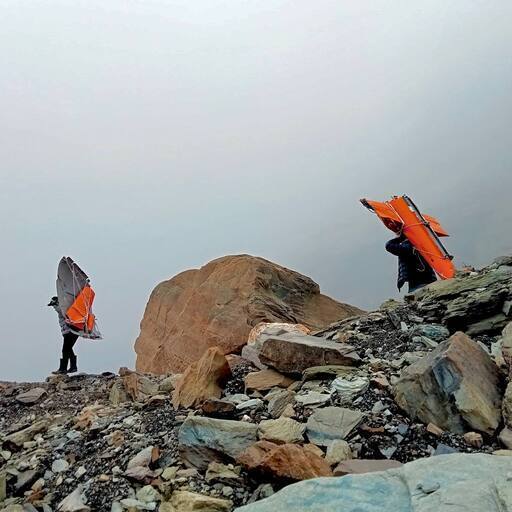
Nepali kids carrying a crashed helicopter debris down from Dhaulagiri base camp to sell it as scrap metal. They wear wool socks with flip-flops or rubber boots on the cold rainy days.
I bought a fake Nepali sleeping bag with -20C written on it, a wool sweater and a third pair of wool socks. Wool proved to be a much better base layer than a conventional $100 The North Face black nylon I had, because it was comfortable when sweaty and because it did not smell. Eventually I was wearing the "base layer" on top of the sweater instead of below it.
I recommend Andy Kirkpatrick's blog for more gear tips.
We were going to camp on ice so I replaced my yoga carpet with a z-fold mattress that had bumps for thermal isolation. One night I felt cold sleeping on it even when it was folded in half forming two layers but every other night it was good. We both had gas catridge stoves and because Alban was carrying the tent I was in charge of the food.
When I was in jail it was discovered by a friend of mine that it was possible to cook buckwheat in a plastic bucket by adding hot water and waiting for 10-20 minutes instead of continiously boiling it in a hot pot for the same amount of time. The produce of this cooking method was also highly esteemed for being al-dente, adding complex texture to an otherwise incomplete dish. With a knob of butter and a garlic it became unironically good.
It is more energy dense than oats, more nutrient rich, it has lower glycemic index and it's easier to digest at the same time. With the alternative cooking method described above it is also highly fuel efficient.
In jail I have also read an American bodybuilding book that introduced the important destinction of animal as opposed to plant protein into my reasoning. I considered bringing cheese and dry meat but my experience with cheese was that I could eat up to a kilogram a day and there was no way to stop me from doing it. While taking some dry meat (which Alban insisted on and it proved to be a great idea), I focused on powder protein mix for the bodybuilders.
It was paired with many kilograms of buckwheat, clarified butter, honey, nuts, dry fruit, fresh lime, many types of tea, ground coffee, tobacco and masala. There was not enough buckwheat in Pokhara and I ended up also bying several kilograms of organic rice from a vegetarian shop that ran out of buckwheat. This was a big mistake because organic rice took an hour to cook at high altitude where boiling water is of a lower temperature than at sea level.
We did not bring any cannabis but found it growing on our way. In late September it was not quite ready for harvest so we spent the evenings after the hikes rubbing the best parts of the plant in our hands to remove the excessive moisture. The resulting hashish product, known as charas, was well smokable and pure. Generally I don't recommend smoking charas in Kathmandu unless you know its source. While it certainly gets people very high it is always seriously contaminated with unknown substances some of which are less bad than the others. Later in Nepal I was only smoking wild cannabis and almost never charas.
Alban cooked great rice with clarified butter, dry meats, salt and masala, served with lime, to insult my sweet buckwheat dish that we both were sick of. He however did appreciate its nutritional value and we experienced almost no muscle fatigue after carrying 20-30kg backpacks uphill for 2 weeks, observing great gains in the ass muscleture instead.
As the dried meat was running out we got generously resupplied with savoury foods in Dhaulagiri base camp by the 2024 Russian expedition. They gave us sublimated soups of which Phở Bò was exceptionally good. This was the first real base camp I saw. One of the mountaneers lacked many fingers and all of them had their noses burned by the sun. Recently they fixed ropes and established a high camp reaching, I believe, the altitude of 7500m for acclimatization.
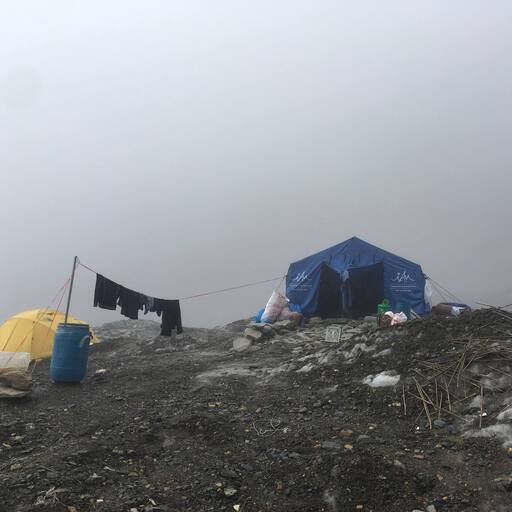
Cooking tent (blue) in common September weather. The basecamp sits on a glacier partially covered with sand and rock. They gathered piles of rocks under the tents to isolate the floor from the ice.
It was around noon and a man walked into the cooking tent for breakfast. He went staraight for the meat but immediately he was dissapoited. When his grandmother encountered such pork she always assumed the pig was fucked by the dogs. I translated the joke to Alban as I did in this text. Except for the meat the other food was deepfried bread and sataued vegetables. Personally I did not mind its roughness and I had a lot of it.
A very young man, when asked about his relationship with death, told me that a year ago his girlfriend died on Dhaulagiri and that's why he wanted to climb it.
They stayed in base camp much longer than was expected because the weather was bad. Many people gave up and left and the remaining ones were negotiating an extension with their ensurance company on the phone.
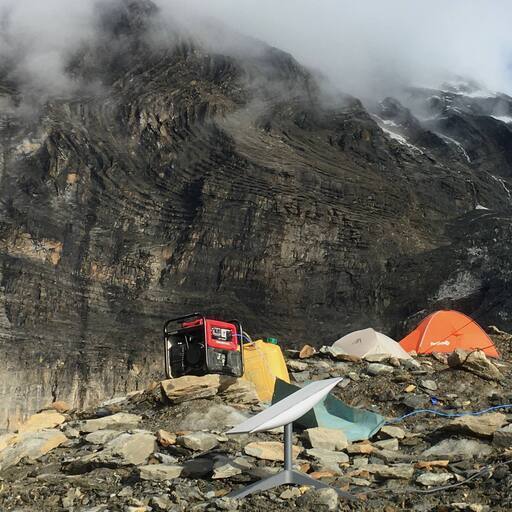
A Starlink and a diesel generator. The base camp was richly supplied by horse caravans. My mcther was very surprised to receive a message from me a week earlier than was expected.
The weather forcast they had was good and in three days they were going to start climbing. It ended up being very wrong. Instead of good weather came a snow storm that lasted two or three days.Eventually eight people climbed Dhaulagiri with two reaching the summit, one turning back and five people dead. The old mountaneer with no fingers was the one who turned back. The young man and the man who made a joke reached the summit.
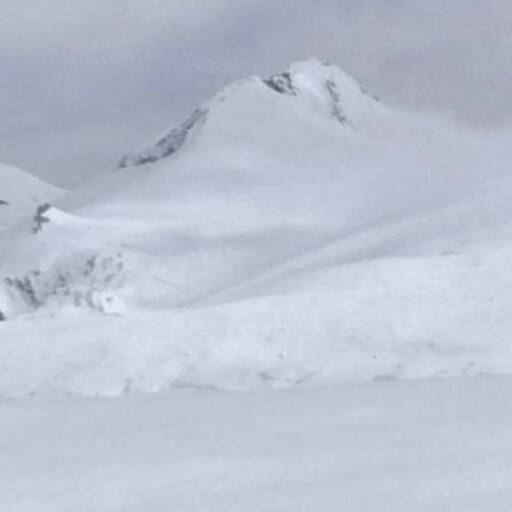
Dhampus peak as it was climbed.
We only reached the tip of the wave-shaped face at 5800m giving up on crossing the summit ridge because of snow conditions on it requiring one more day with a night in a high camp the supplies for which were left at the bottom.
When it started to snow I felt like I was asleep and drunk for years that I spent in the tropics and finally I woke up and I was myself again.
It did not stop to snow on the first day nor on the first night. At night there was not enough air in the tent to breathe because it was buried under the snow. It was not easy to get dressed and go out into the cold to dig out the tent. We slept but after some time there was no air again. It was a kind of sleep when one doesn't know if he is asleep or awake. After I really woke up I was still asleep because there was no difference anymore. There was no will and it was impossible to move.
In the morning the suffocating air got hot because of the sun. However only in the evening of the second day the snowstorm was completely over and we could move the tent close to the mountain. We did not consider waiting for the snow to compress under its own weight because we were running out of gas and because it was uncomfortable to camp. We choose a windy spot for the tent to avoid being buried which resulted in a very cold night.
My shoes froze and I decided to put on a pair of socks, then a pair of plastic bags and then another pair of socks. It worked very well. On the mountain the snow was deep and walking was often impossible. We dropped the backpacks and crawled uphill using both legs and arms going for the west ridge that had visible black rocks. It was easier to climb the rocks than to crawl in snow.
As I was writing the story I thought about the reasons why we turned back on the summit ridge and nothing precise came to my mind. But as we were there, it was obvious and there was no thinking at all.
Alban wanted to run down the snow face fast instead of using the old way. To me it looked bad because I saw an avalance a little left from the place he wanted to go. He went anyway, which greately irritated me. I finished the summit chocolate without leaving a piece for Alban and, since there was no alavalanche, followed his descent route. At sunset we reached the backpacks and began the long descent into Kali Gandaki Gorge. It went along the South-West ridge that we originally planned to climb.
We joined some trail of steps in the snow and soon found its origin, a caravan of horses returning from Dhaulagiri. It was good to follow the caravan but still when I followed Alban it was much easier to walk on his steps than when I was ahead of him and only used what was left from the horses.
I saw blood on the snow and the caravan stopped as it did once before. One of the horses collapsed on the ground. The men kicked the horse with their boots and it rolled down into the snow but it did not stand up. The caravan went on leaving the horse to die. They went much faster now and I could not keep up with them.
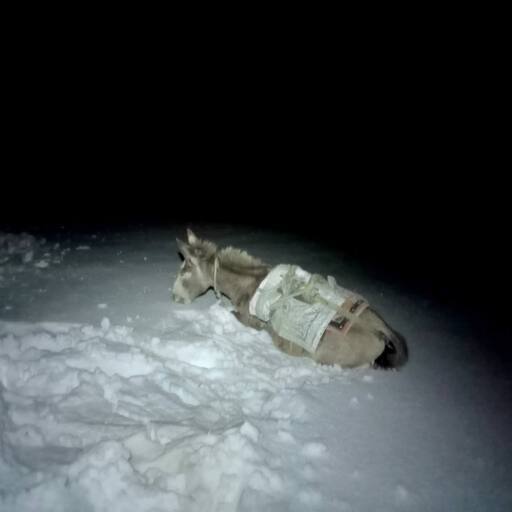
Alban stayed with the horse, attempting to transfer his lively energy to save the animal in a state of meditation. It was difficult as he himself had very little of this energy left and the horse was much heavier. The horse was all red and the snow was also red in the light of Alban's headlamp. The blood on the snow was black as was the sky and everything far away. It was the same for hours. The bright red light of his lamp whipped the horse's eyes and made it sleep. Now the horse saw the dull light coming from the horizon where the warm sun appears in the morning. The snow was cold and the horse craved the sun. Alban followed the horse as it went towards the dull light but he could not keep up with its speed. He followed the footprints and the dull light was getting a little brighter but there was no horse. It became so bright he could see nothing at all now and it was day so he opened his eyes.
He was standing in the light of my headlamp.
"What did you do with the horse?"
"Magic," Alban said. "I tried to save it with magic. Please turn off your headlamp -- it's too bright for my eyes."
"Did it work?"
"No, it was too late. I'll go first now. I don't like your white headlamp, so keep some distance."
We reached the bed of the valley before sunrise. All his remaining energy went into the horse and on the next morning Alban woke up blind.